This project is part of an on-going research, drafted as a PhD pitch in February 2025.
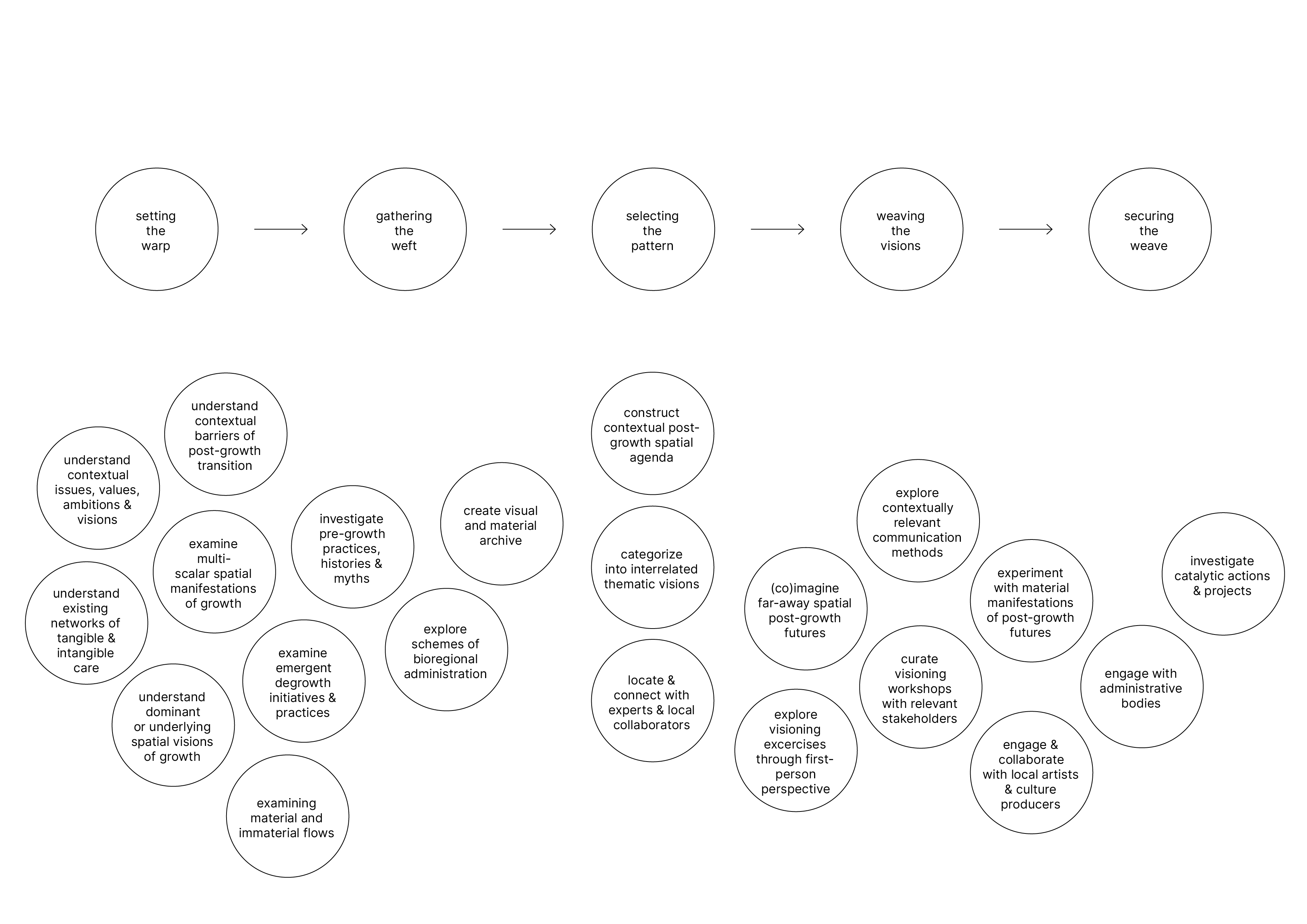
In times of uncertainty about the state of the world — caused by continuous ecological catastrophes and ever-rising social injustices — being able to imagine alternative futures beyond growth-centric thinking is a radical act. However, traditional urban planning remains short-sighted, failing to integrate critical visioning processes. At the same time, post-growth studies have hitherto remained confined within academic discourse or small-scale initiatives, and have not engaged extensively with urban studies. Addressing the gap in operationalisation within the post-growth spatial planning, this paper proposes a Post-Growth Vision Weaving Tool — a structured yet flexible methodological framework for spatial thinkers that aims at constructing critical, engaging and contextual spatial imaginaries beyond growth-centric thinking. This experimental tool bridges theory and practice, imagination and action, spatial planning and art, by integrating analytical- with art-based methods of research and design — like art-making, fiction writing, speculative futures design, counter-mapping, tactical urbanism or participatory visioning — broadening the scope of traditional planning processes. Conceptually structured through the process of weaving, this tool proposes five components: (a) setting the warp, or examining the region through a post-growth lens, (b) gathering the weft, or investigating local ambitions, goals, histories and visions, (c) selecting the weaving pattern, or constructing a contextual post-growth agenda, (d) weaving the threads, or exploring the agenda through distant spatial futures, resulting in a post-growth imaginary, and (e) securing the weaving, or reflecting and examining catalytic actions and spatial interventions. Also, this paper argues that a bioregional approach to territorial planning is crucial for envisioning a post-growth planning paradigm, as it can create the conditions for a faster application of post-growth policies, by translating abstract planetary-scopal ideas into place-based actions, by empowering regional cooperation and decision-making, and by bridging politically-polarized stakeholders. In order to test the proposed Tool in a real-world context, the challenging case of the Greek region of Attica is used as a case-study, locating potential limitations and challenges. Overall, by centering post-growth thinking as the foundation of spatial planning, this research contributes to a paradigm shift in how we can conceptualize, communicate and enact spatial futures. It posits the role of the urban planner as the Weaver — the one who curates, translates and interlaces diverse stories, imaginaries and ambitions into actionable spatial futures. In doing so, this research advances both the theoretical and practical dimensions of post-growth thinking, offering a varied and creative methodology for envisioning the era beyond growth.