graduation project, 2021
mentor: Alcestis Rodi
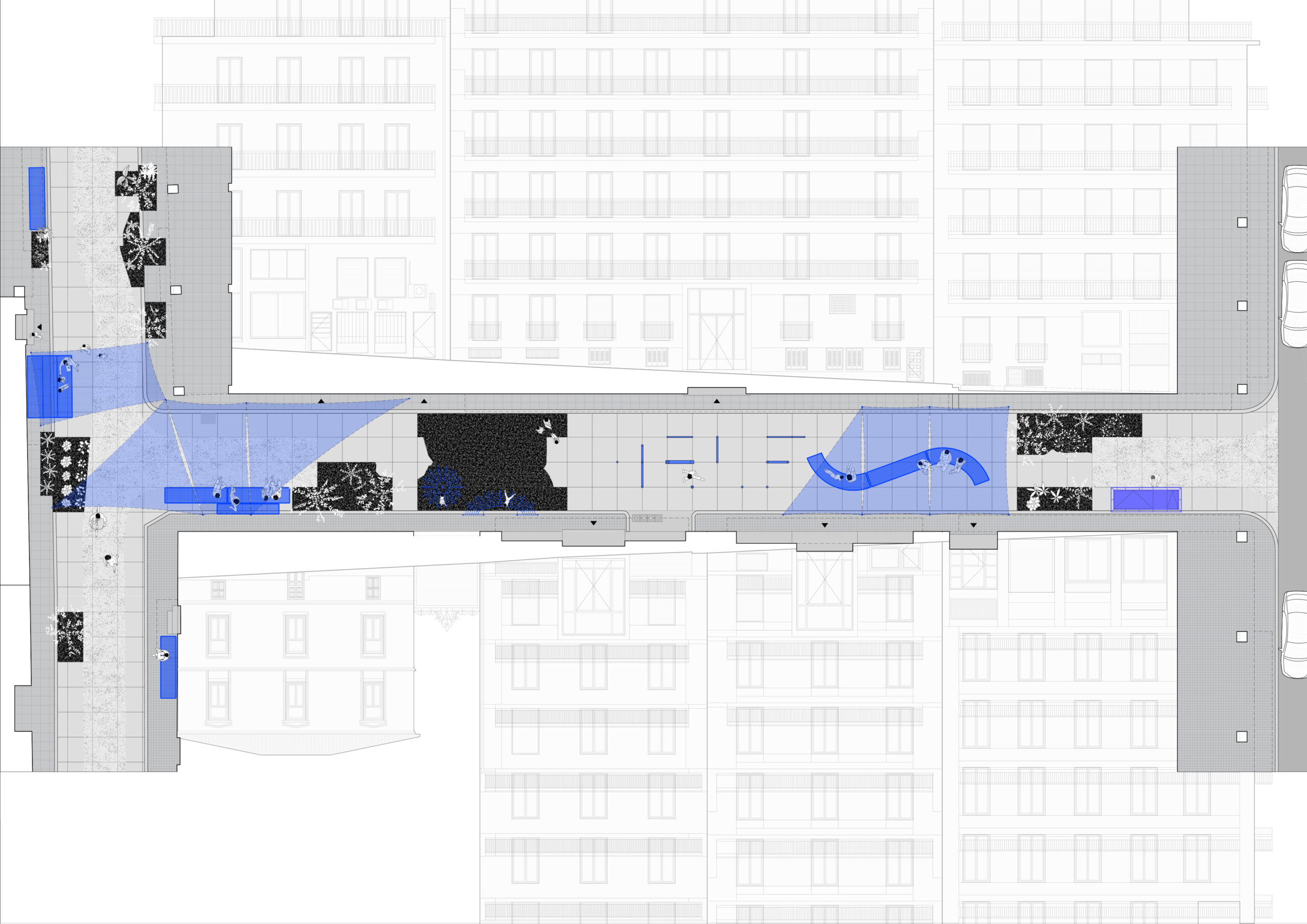
Following three existing contemporary paradigms of urban design – the Superblock of Barcelona, One-minute-City of Sweden and the contemporary acts of Athenian Informal Urbanism – my design thesis focuses on the definition of a strategy for the reclamation of the street as quality public space. With my selected site as my neighborhood of Neapoli, Exarcheia, the three strategies merge into one, creating three superblocks, with limited traffic at the in-between zone, with the road as the main tool for urban hyper-local regeneration. This strategy produces roads of reduced traffic with a meandering path for bikes and emergency vehicles, and most roads of free space. For the re-habitation of the new space a set of tools is designed. Firstly, a tactic for the new materiality is proposed, referencing the work of Julie Bargmann of DIRT Studio. The existing planting patches are extended in both the sides of pavement and road, and a white-topping cement is added in a new grid on top of the existing asphalt. A series of urban furniture is designed to act as place-holders of rubble produced from excavations, renovations etc. A shading system is implemented by placing 3.5m heigh poles at the holes left from the removal of the parking poles, and connecting them with fabric canopies. The implementation of the strategy is presented through a typical part of the central road Mavromichali, and four roads of free space. Trapezountiou street is converted into a play road, in Valtetsiou street the relationship between urban furniture and shop-owners, in Dervenion street, an already existing paved street, its character is intensified and in Komninon street a new vertical garden is formed.
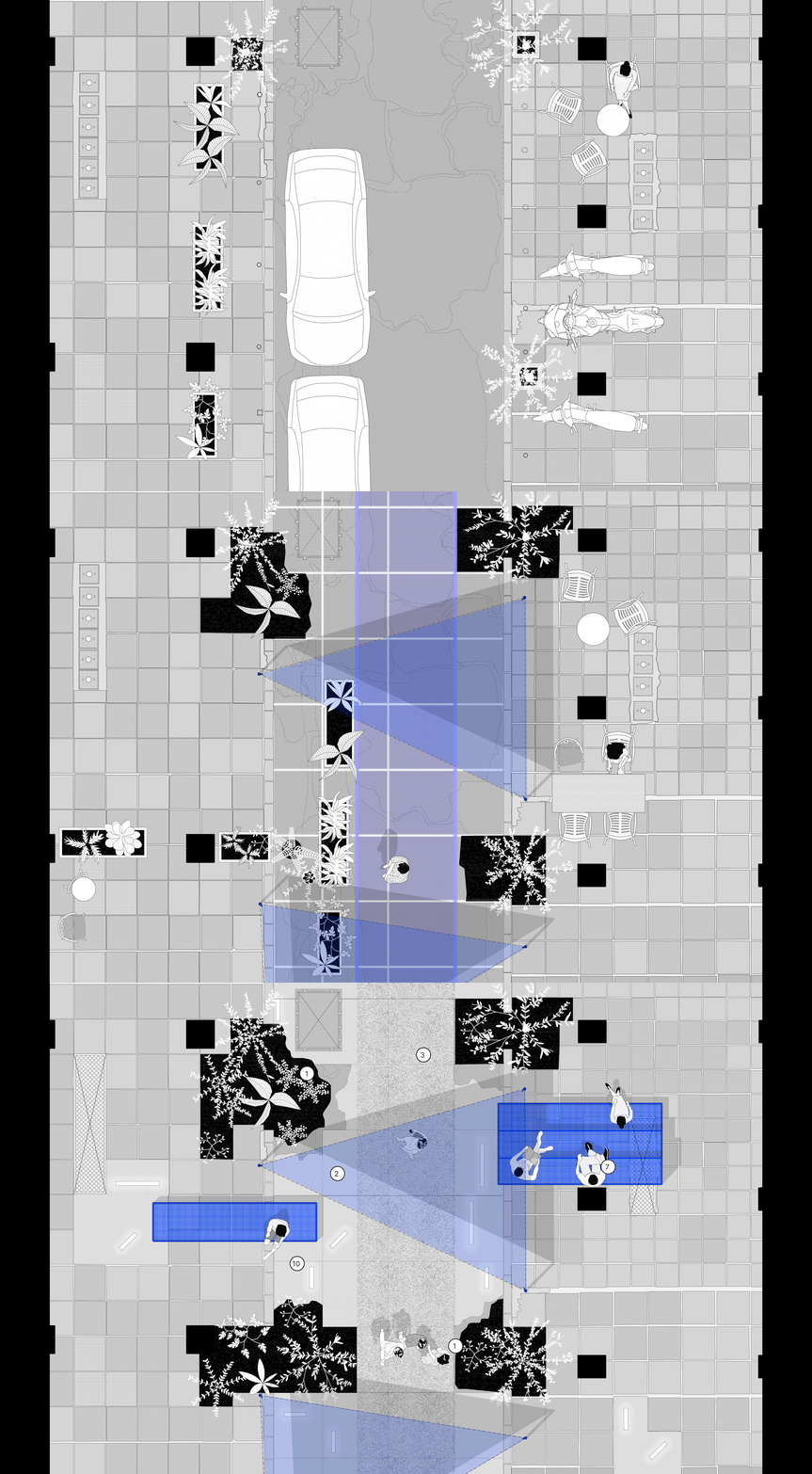
Mavromichali is examined as a typical neighborhood street, with small pavements, stoas, limited public green and overcrowded streets parked cars and scooters. The project proposes a pilot stage, in which traffic is limited gradually, a slow traffic zone is marked with paint on the asphalt and the existing planting patches are expanded. The final stage includes new paving, urban furniture and lighting.
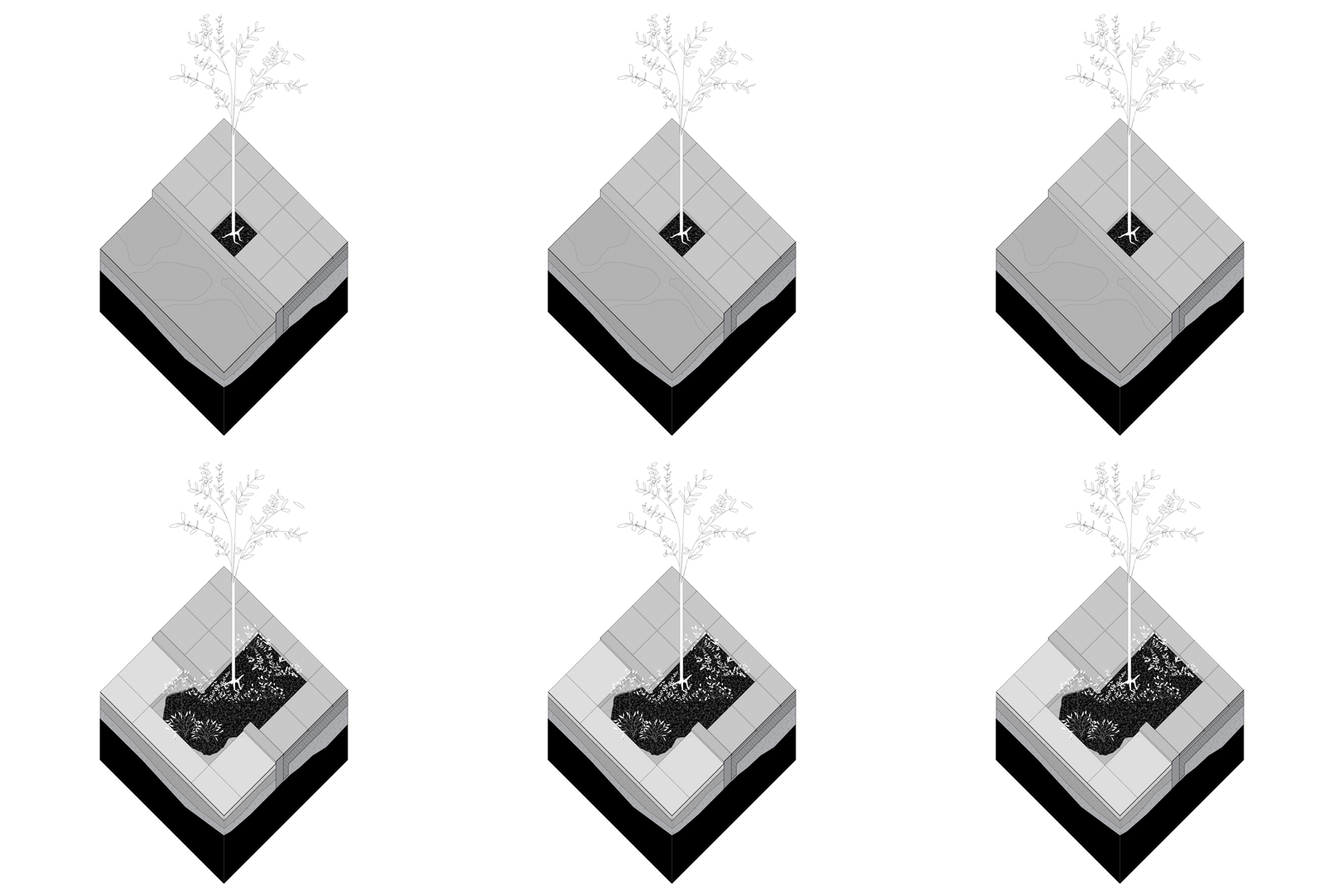
- the already heterogeneous palimpsest of the athenian paving is intensified, existing patches of soil are widened and paving tiles are removed
- bridging the two uneven sides of the sidewalk through site-specific application of whitetopping cement
100-150mm portland cement to match height of curb, control joint 1.2 x 1.2m grid, expansion joint 3.6m grid - slow traffic bike or pedestrian path denoted with aggregate in the concrete
- steel poles fixed on existing holes in the ground left from the removal of parking poles through chemical anchoring
hollow section t:5mm ø:50mm H:3500mm - multi-purpose rotatable hooks
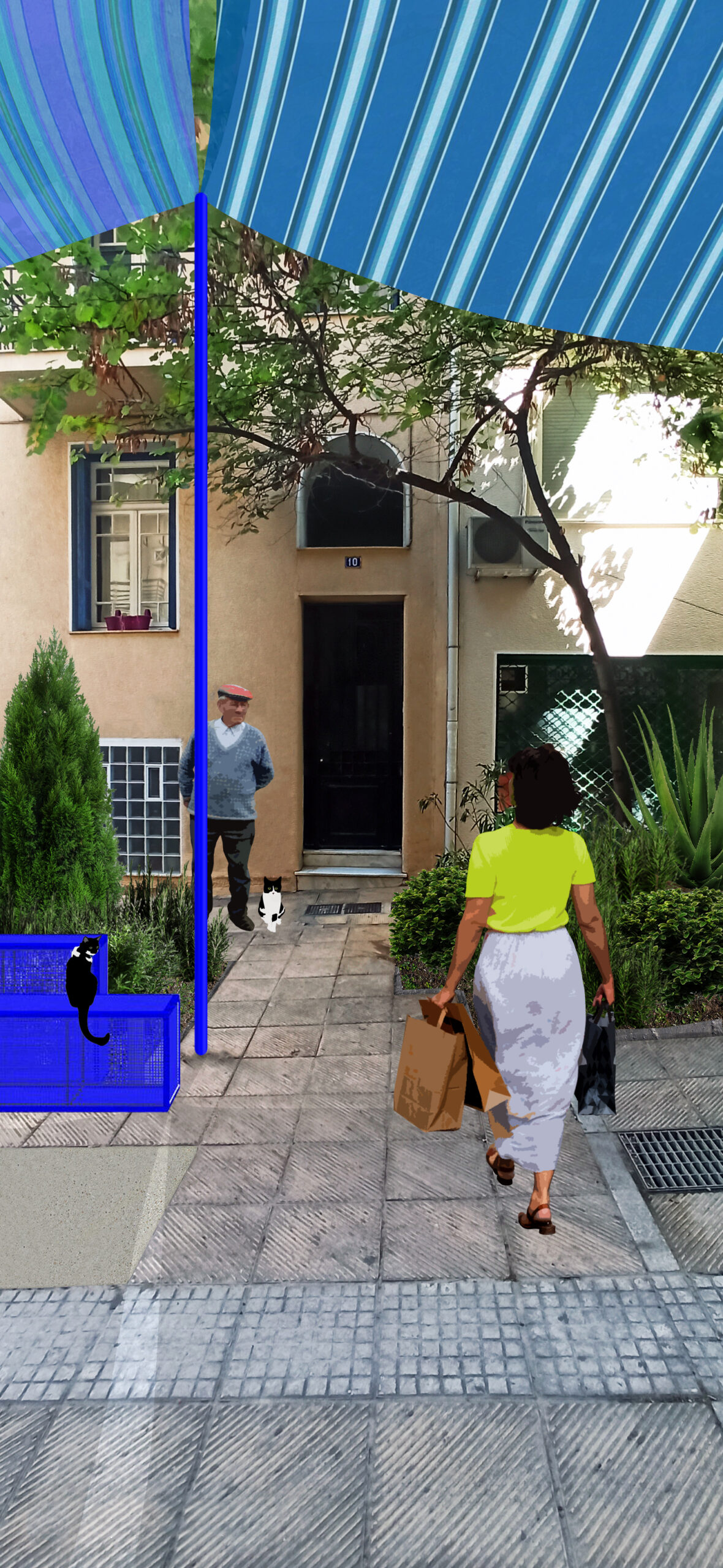
- light-weight fabric canopies are attached to rotatable parts of poles through hooks, the pattern and colour schemes vary per neighbourhood and are decided by the local residents
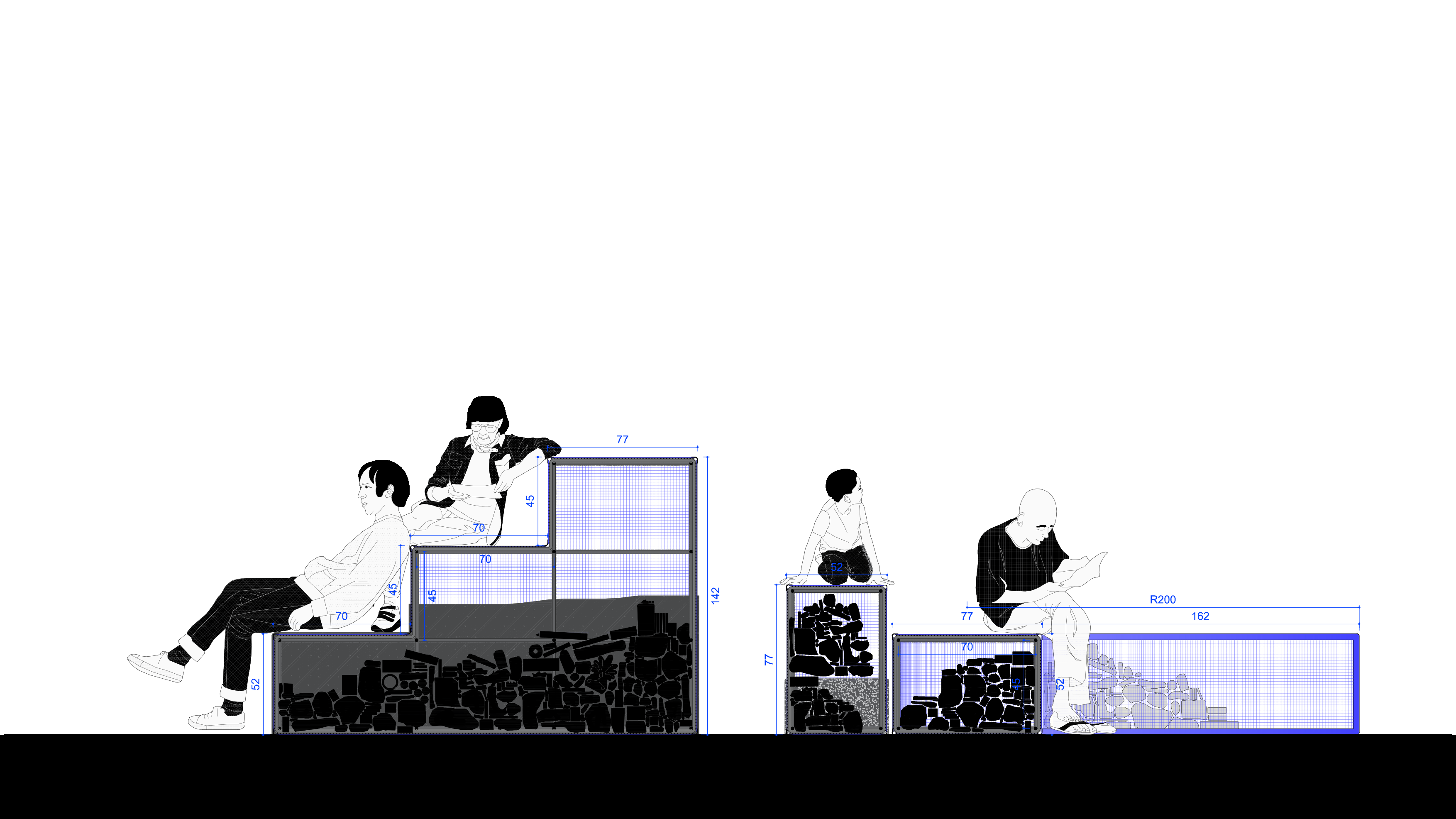
- gabion-style public furniture:
internal rebar structure 15mm thickness, 700x450x500mm grid with spray-on epoxy corrosion resistant coat, covered with steel mesh, 4mm thickness, 150mm centre to centre, spray-on industrial epoxy coating in RAL5010 Gentian Blue with UV Polyurethane topcoat satin finish 50% gloss
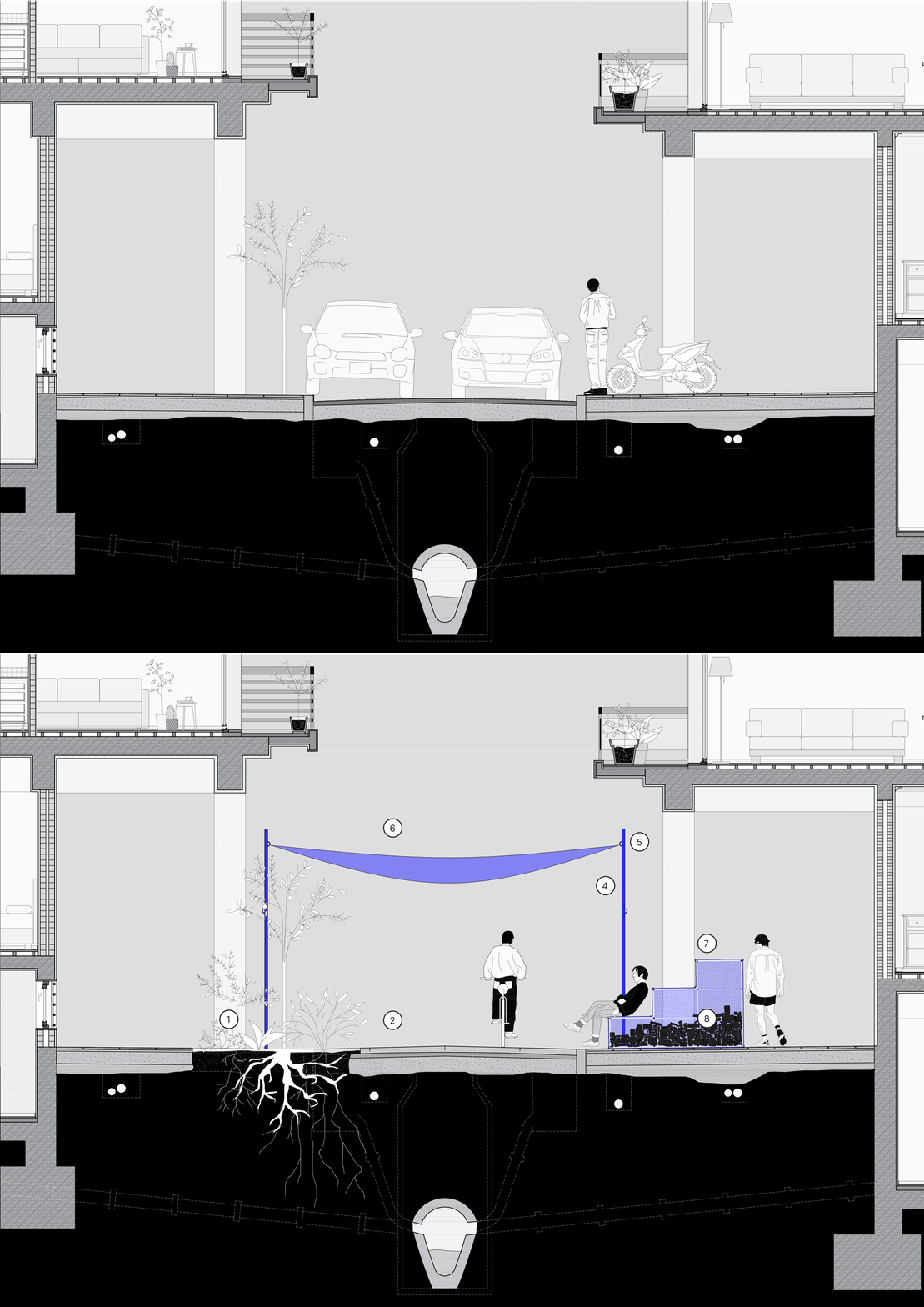
- filled with non-hazardous rubble from the renovation of apartments or public works (like concrete, stones, bricks, tiles, ceramics, untreated wood, glass, copper, bronze, brass aluminum, steel)
- initially, the public furniture is lightweight enough to move around, testing their positions on-site, but over time they are cast with layers of concrete, with the rubble inside acting as aggregate, finalising their positions in public space
- in-ground linear luminaires IP 67 with safety glass and stainless steel housing
urban furniture
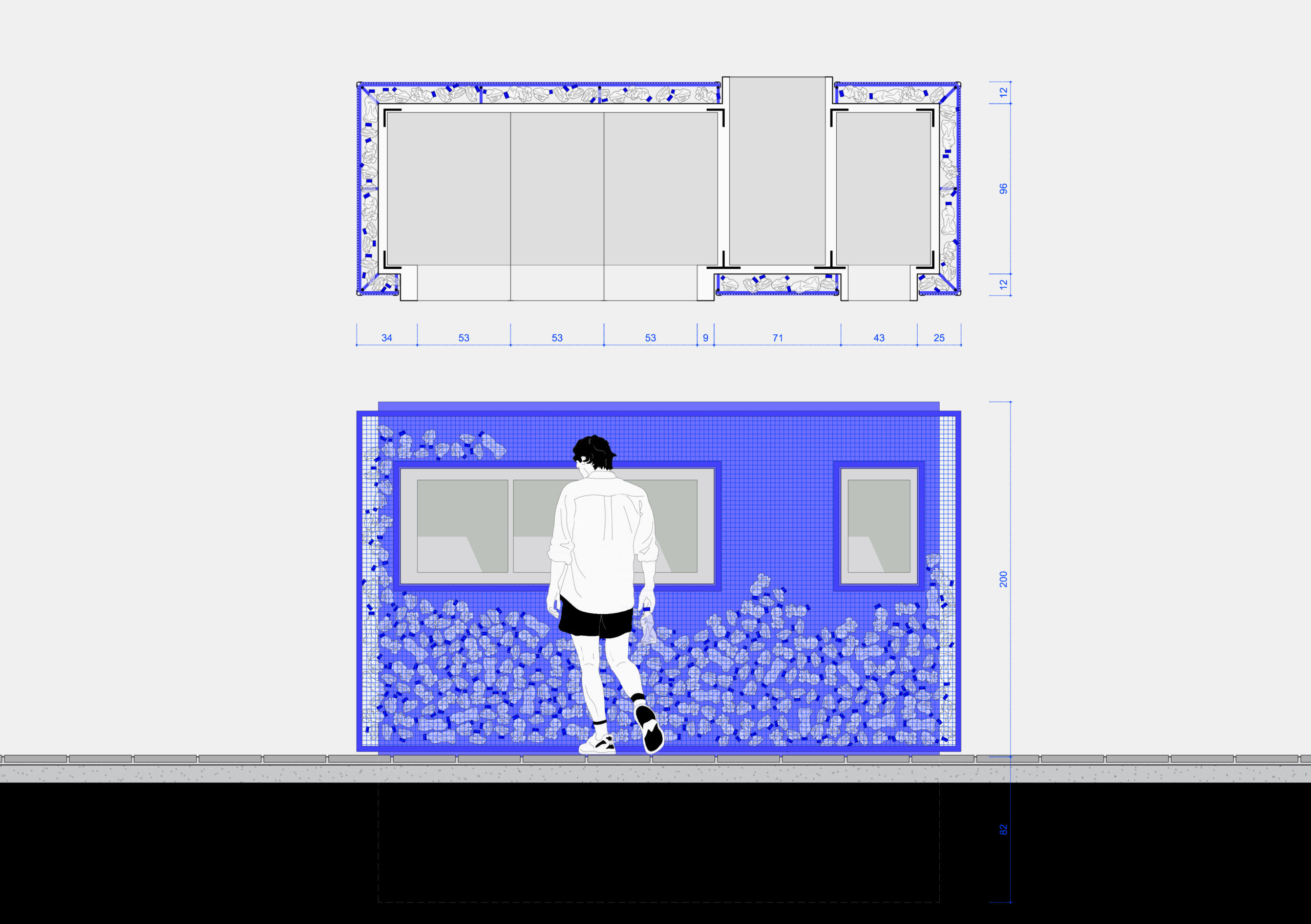
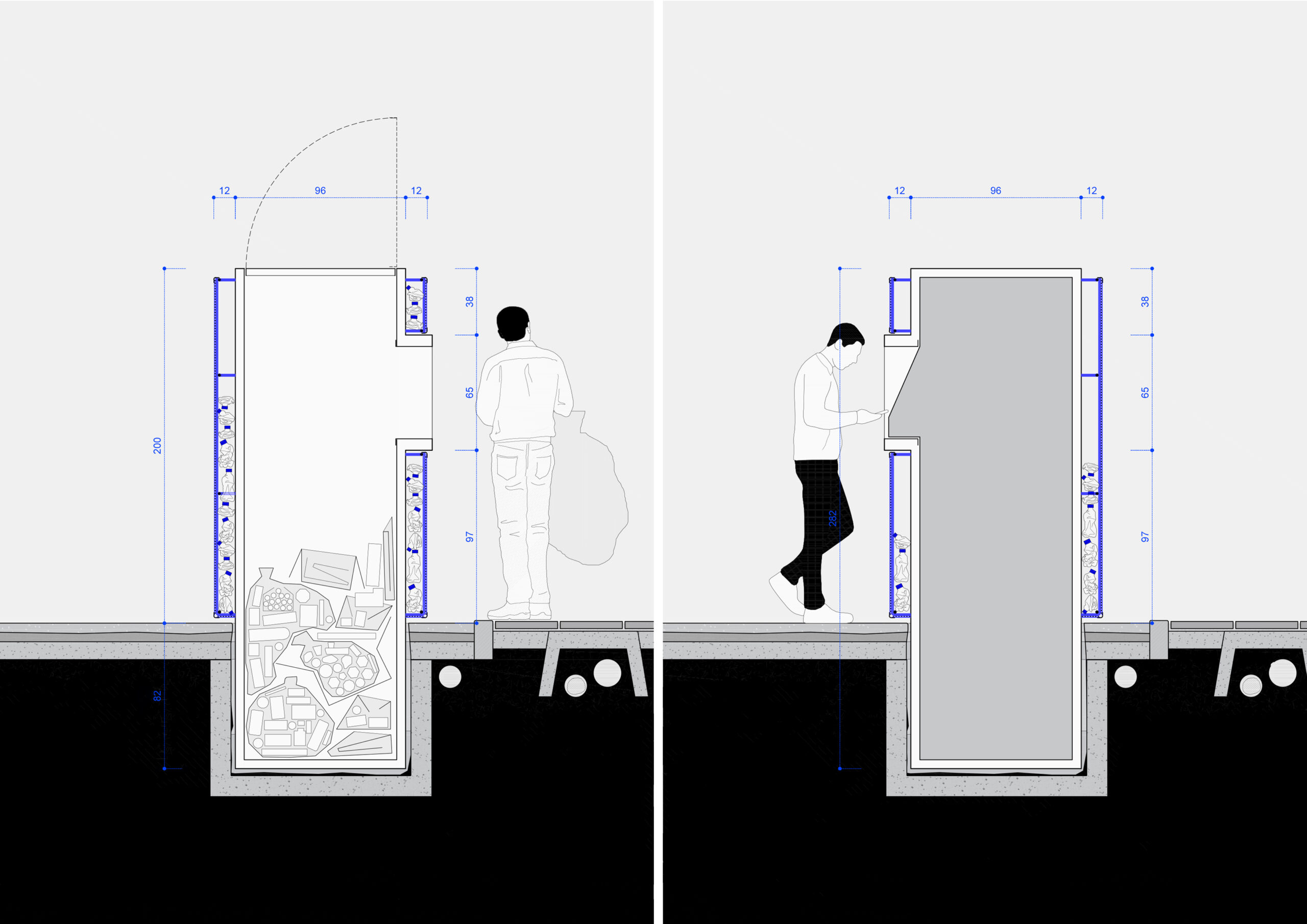
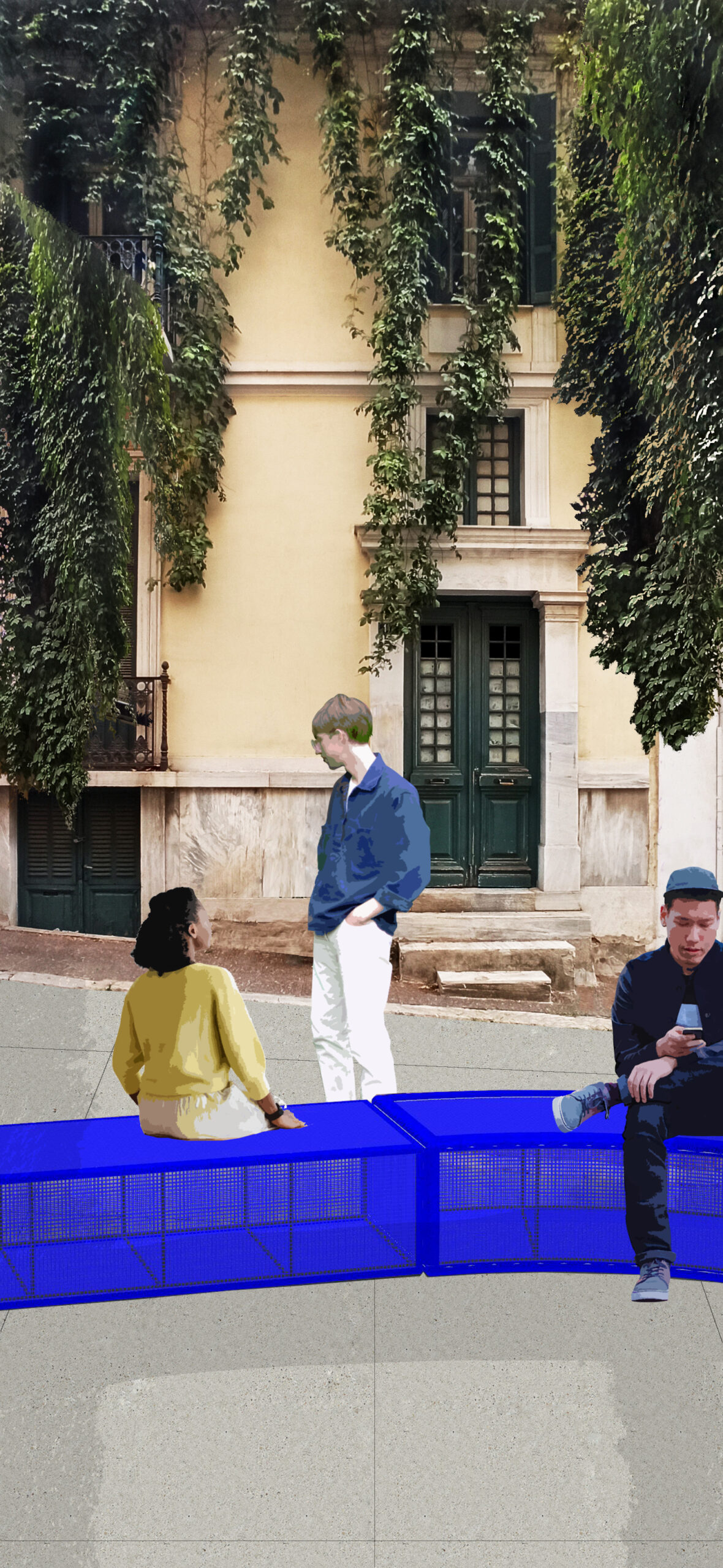
For the design of the new urban furniture I looked towards an object that is seemingly always present at the city streets – the construction debris bin. They are situated outside of sites of renovation or construction, occupying precious public space. In order to create a new circular economy, I’ve designed three furniture typologies, in the form of gabion boxes, but with reclaimed rebar structure: a curved, rectangular and podium. Non-hazardous rubble can be gradually stored inside them, and once full can be taken away to be emptied. As a final stage they can be cast with concrete, making them heavier and their position in the public space more permanent. The proposed urban furniture can be adapted by store owners to suite their specific needs, creating a more cohesive public space. Also, following a similar aesthetic is the proposed urban bin, which combines waste with info point for public services. The exterior of the bin displays waste like plastic bottles, encouraging proper recycling.
Valtetsiou as vibrant street
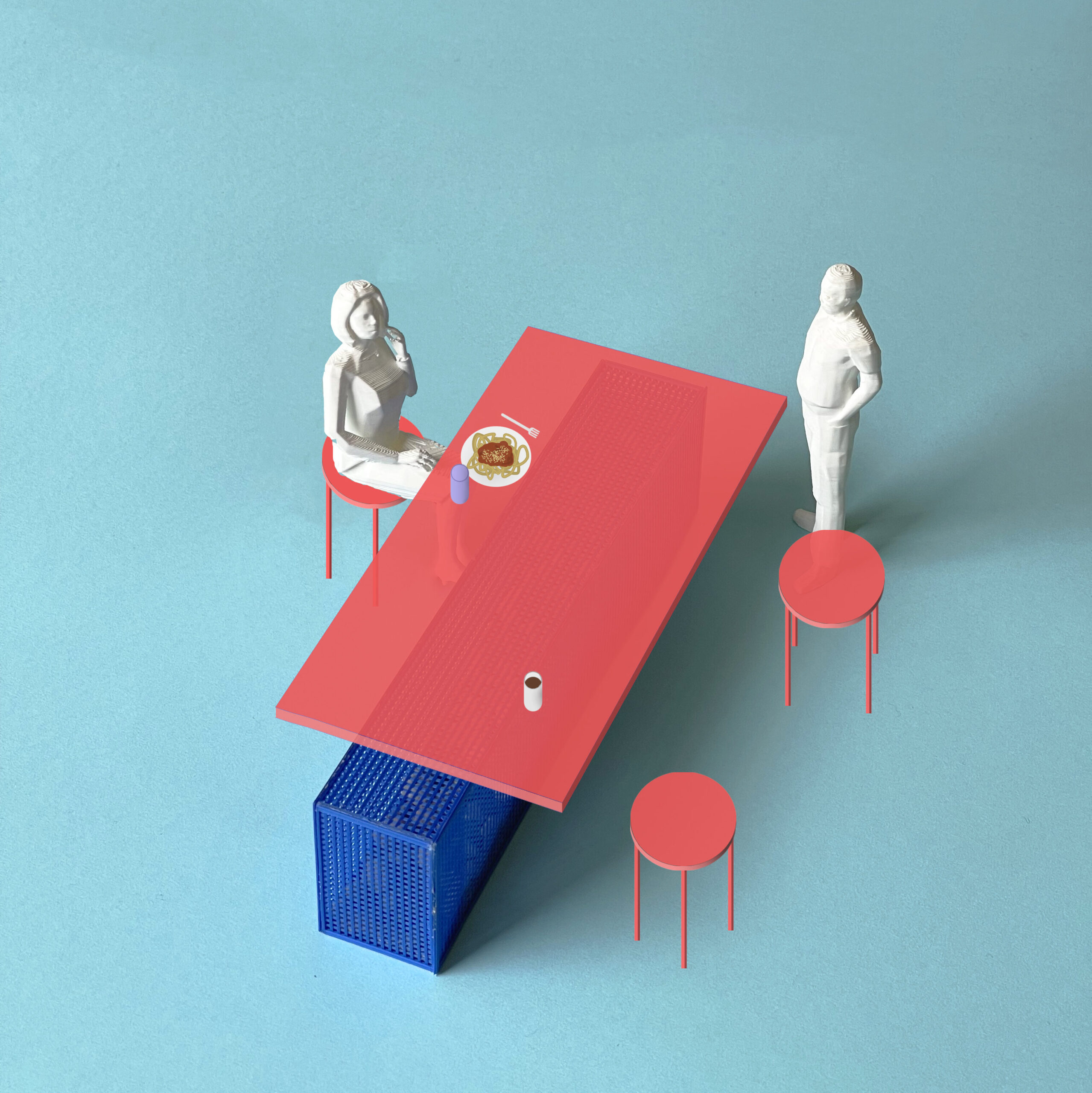
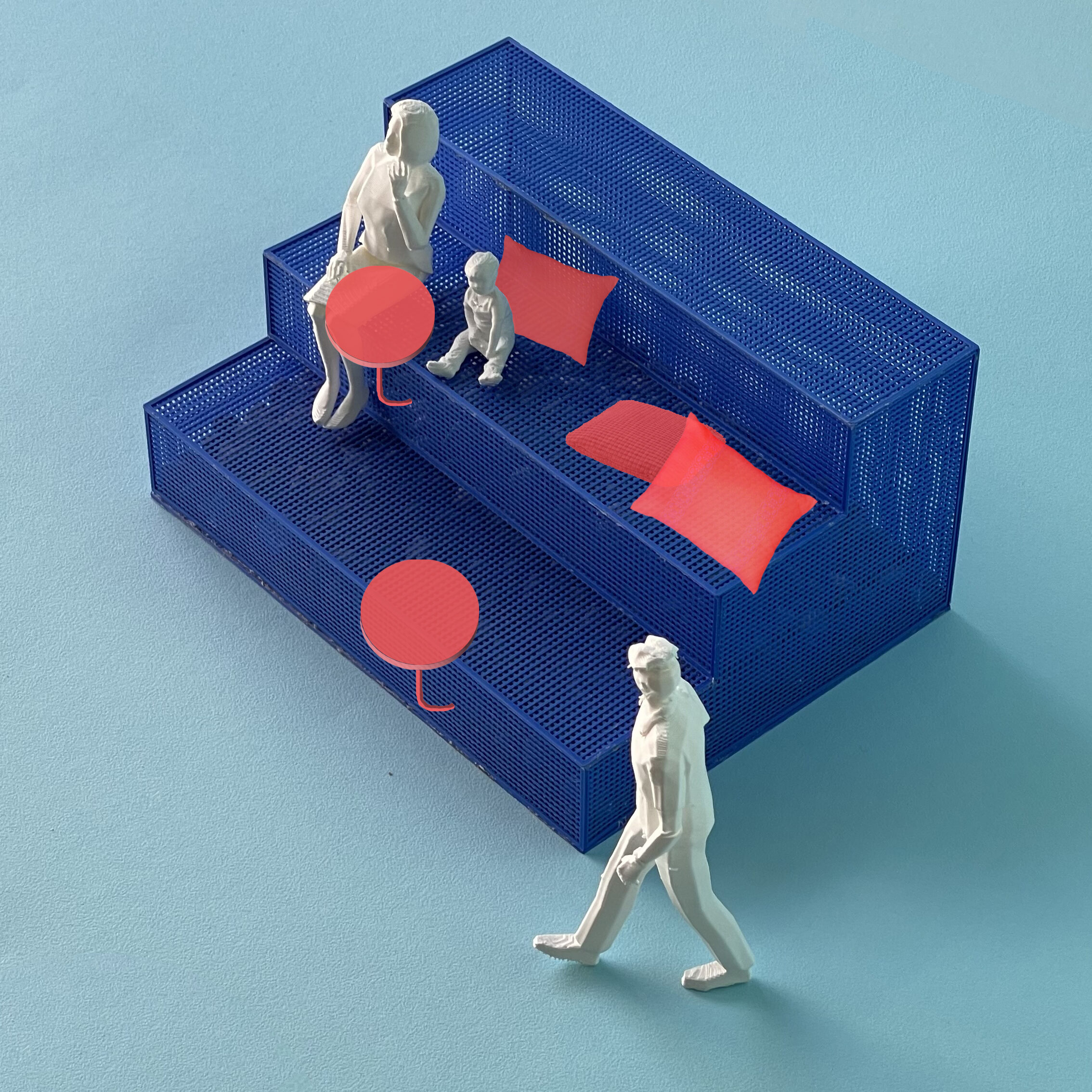
This is a small street with many cafés, bars and restaurants, that is very popular with young people for its vibrant nightlife. The interplay of the new tactics and shop-owners was researched here. Aiming for a sense of homogeneity that would contrast the chaotic Athenian public space, the new urban furniture could be rented and adapted for retail use. For example, a bar has fixed circular surfaces as tabletops on the podium furniture, along with pillows to make it more comfortable for sitting for longer periods of time. A restaurant has flipped the rectangular furniture on its side to make tables, by fixing a surface on the top. Also, to accommodate the heavy pedestrian use a shaded pathway is created, along with a rose garden outside of a beautiful neoclassical building.
Komninon as garden street
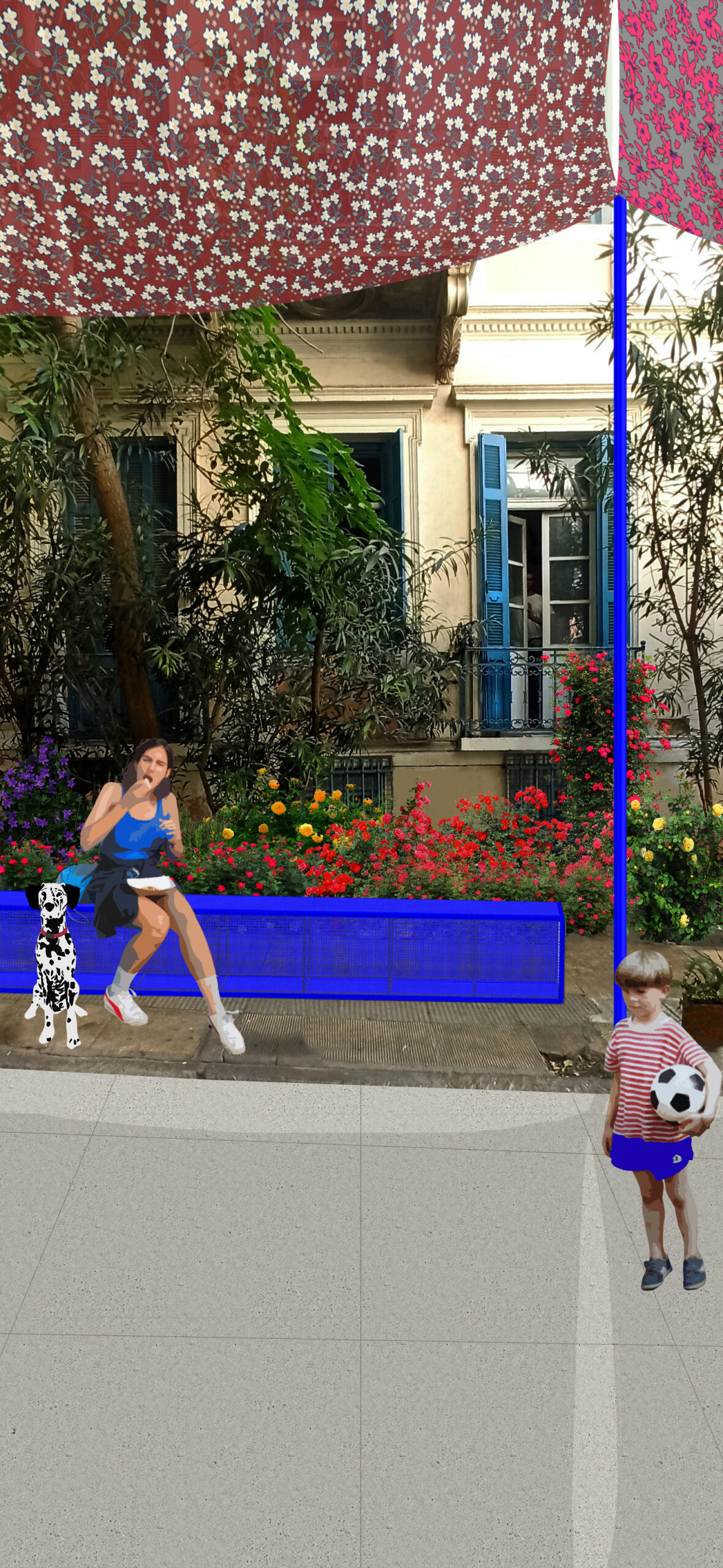
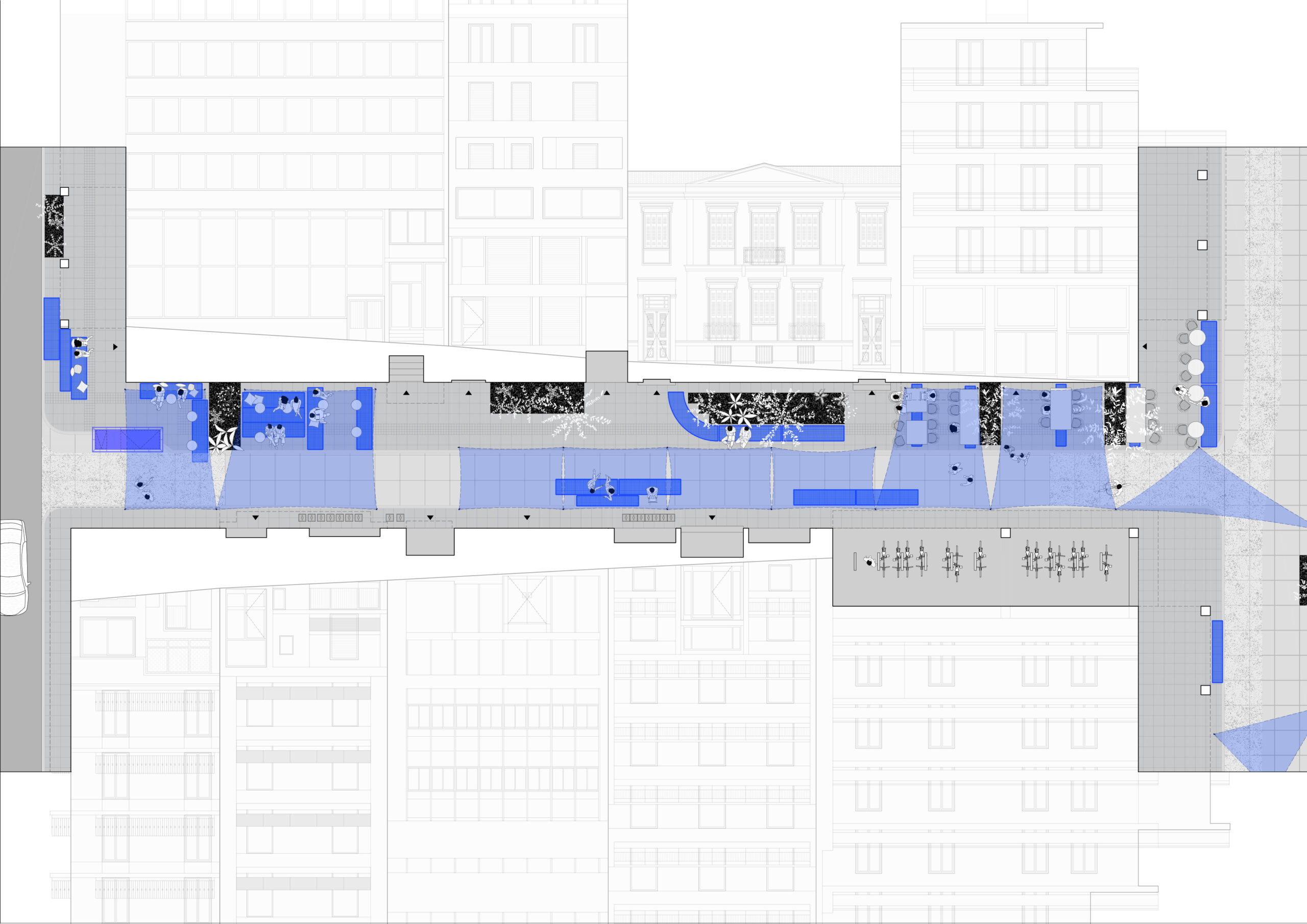
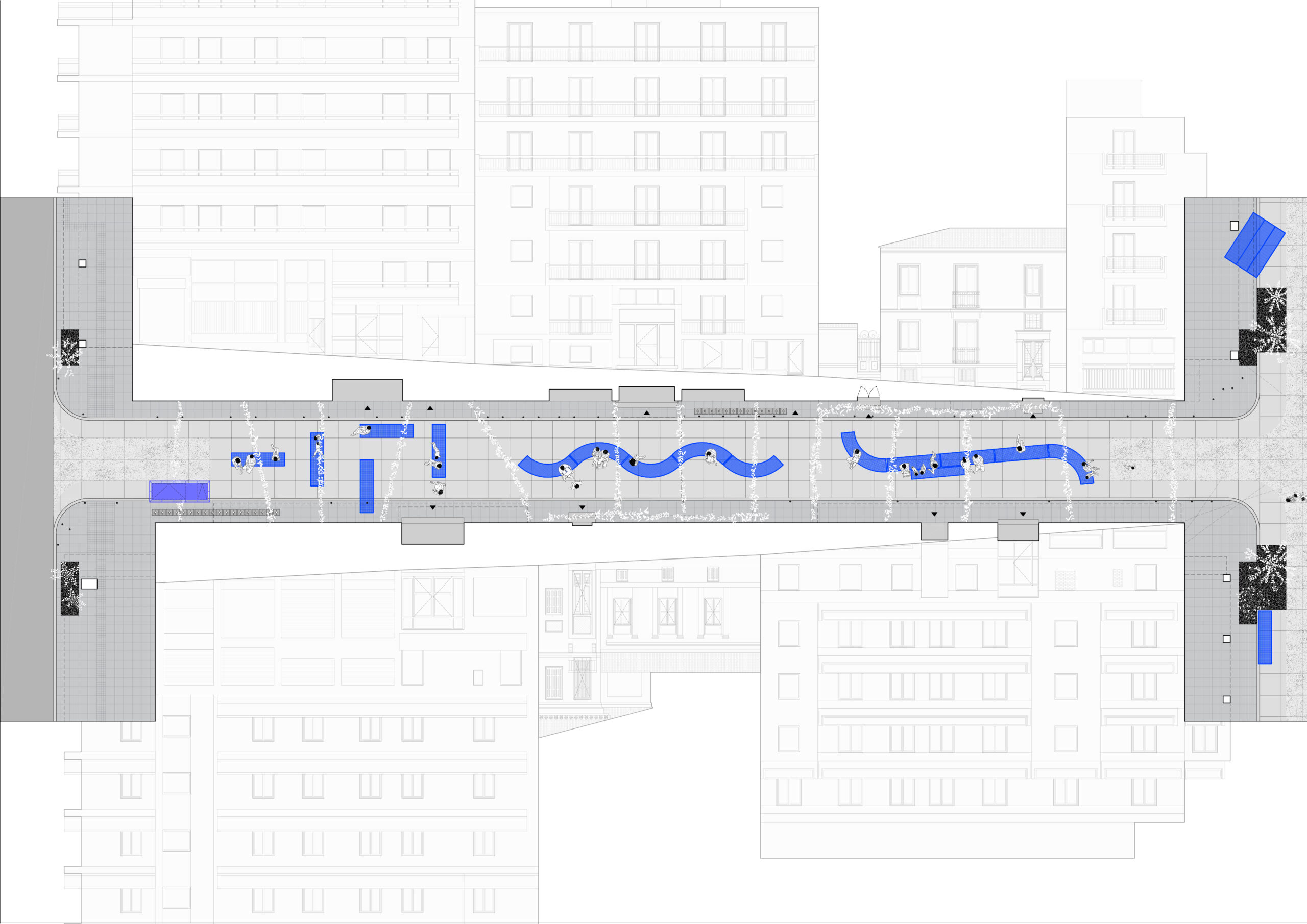
A rather typical street with an intriguing element: an electrical cable between two neoclassical buildings is covered with hanging plants making a curtain-like structure. Instead of one cable, the thesis proposes an increase to thirteen, with the foliage expanding to the whole of the street. In this way, a suspended vertical garden is created. The public space underneath is kept minimal, with no planting patches, but with only the urban furniture in different configurations: a rectilinear, using only the rectangular furniture, a curved formation and an elongated seating formation. While this may be an open-plan urban space, it provides the feeling of distinct “subsections”. The vertical planting also acts as curtains, filtering the sunlight to create a better street micro-climate.
Dervenion as parklet street
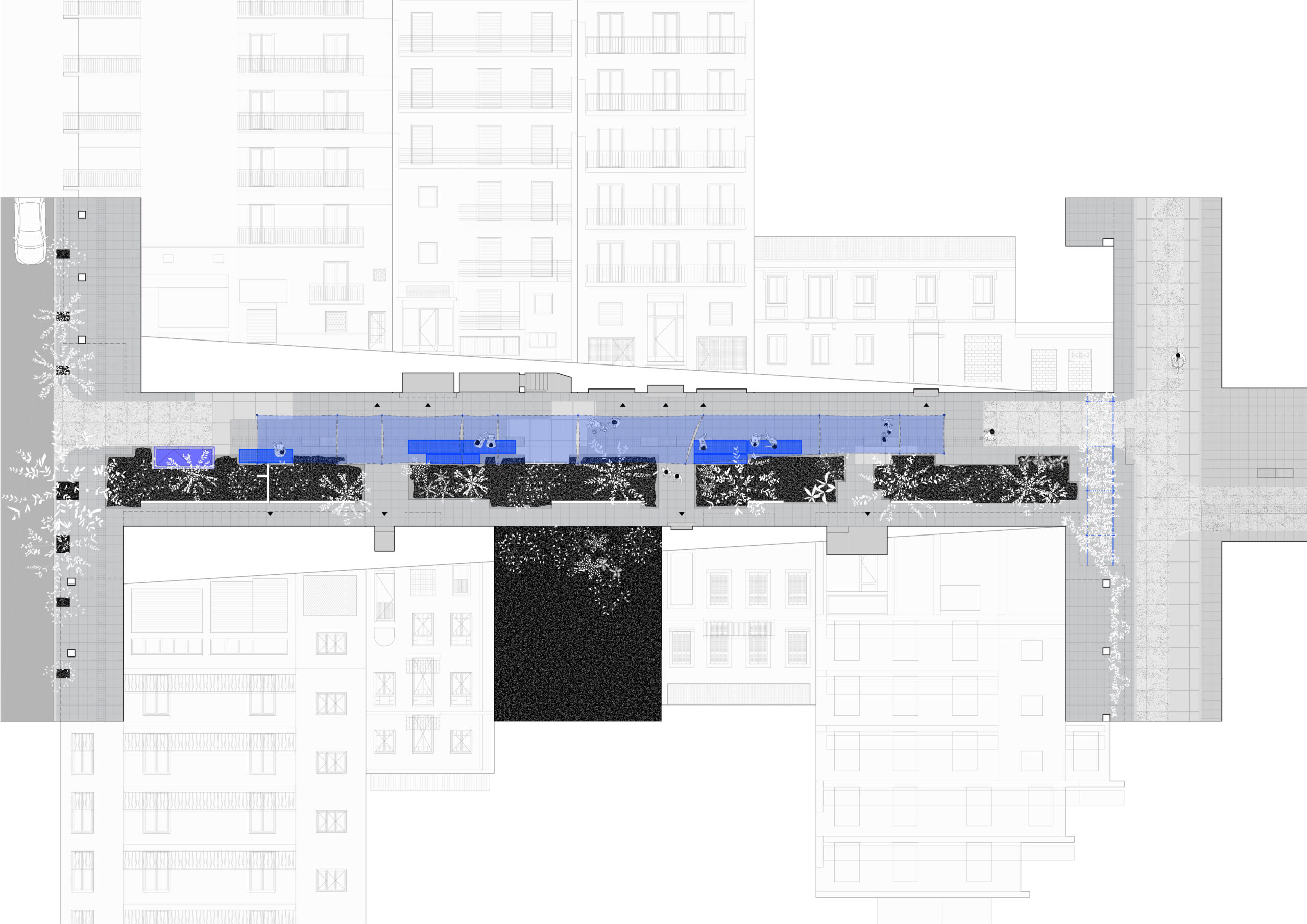
The examined section of Dervenion street is pedestrianized and paved, with tall platanus trees, that has very little exposed soil and almost no public seating. The existing pavement tiles are preserved in the examined scheme, with the new materiality being introduced gradually, when excavation for public works is conducted. The planting patches are extended and the new urban furniture are placed along the path. The shading system is placed at the spots of the existing parking bollards, creating a continuous shaded path. Overall, the green character of the street is intensified into a segmented park that is gradually expanding – perhaps in the future the green will swallow the whole street.
Trapezountiou as play street
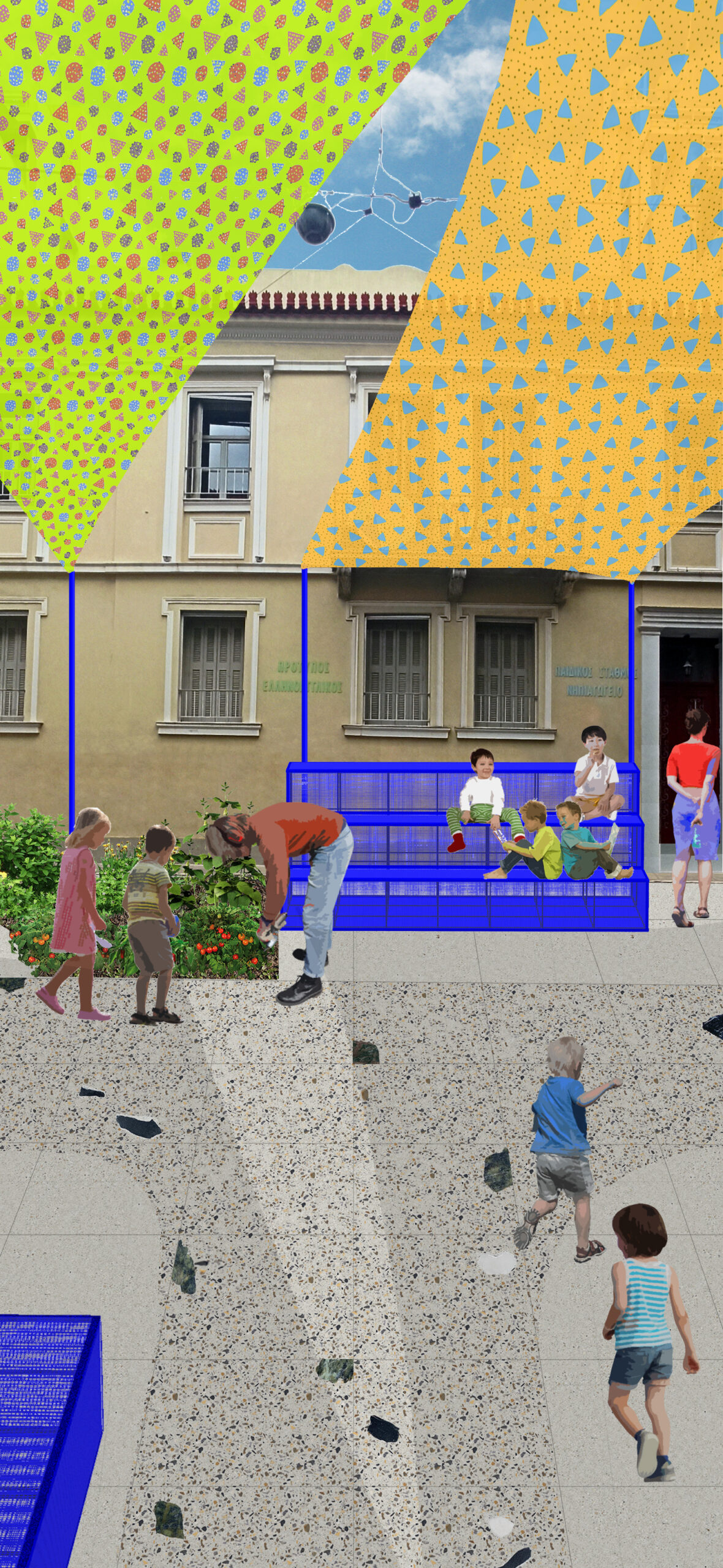
A small street that connects Mavromichali and Charilaou Trikoupi Street, with a kindergarten housed in a neoclassical building that has a very small courtyard. The high number of children in the neighborhood and the lack of open play space urges here the residents to decide to transform this street into a play street. Outside of the kindergarten a small vegetable garden is planted, with the podium furniture for gathering and learning. The entrance is marked with colorful canopies, providing a shaded spot for activities. Next to a pebble play pit with planting, a play “garden” is formed, by repurposing the removed parking bollards. The central path along Mavromichali is shaped on the ground by laying the reclaimed debris/aggregate.